
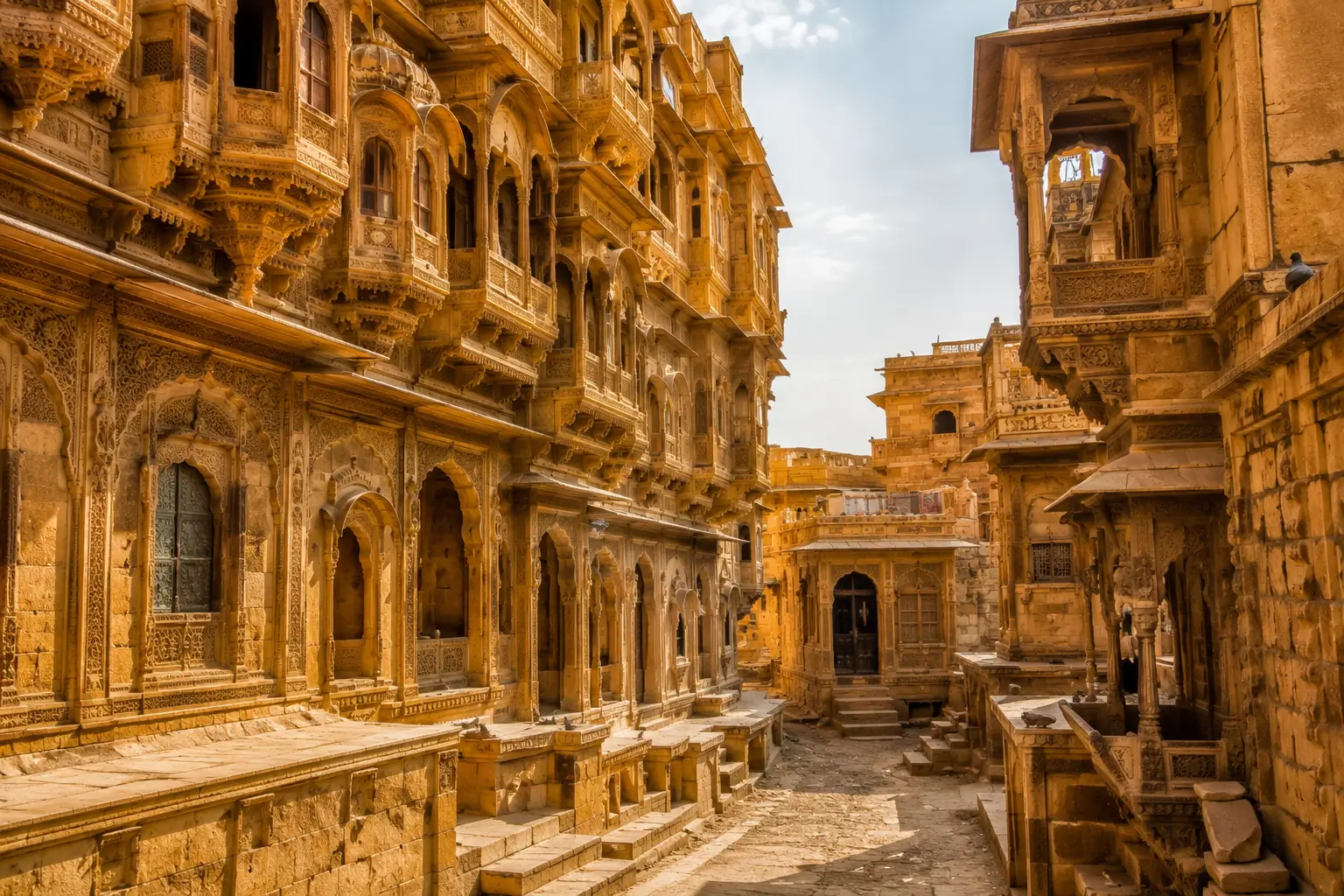
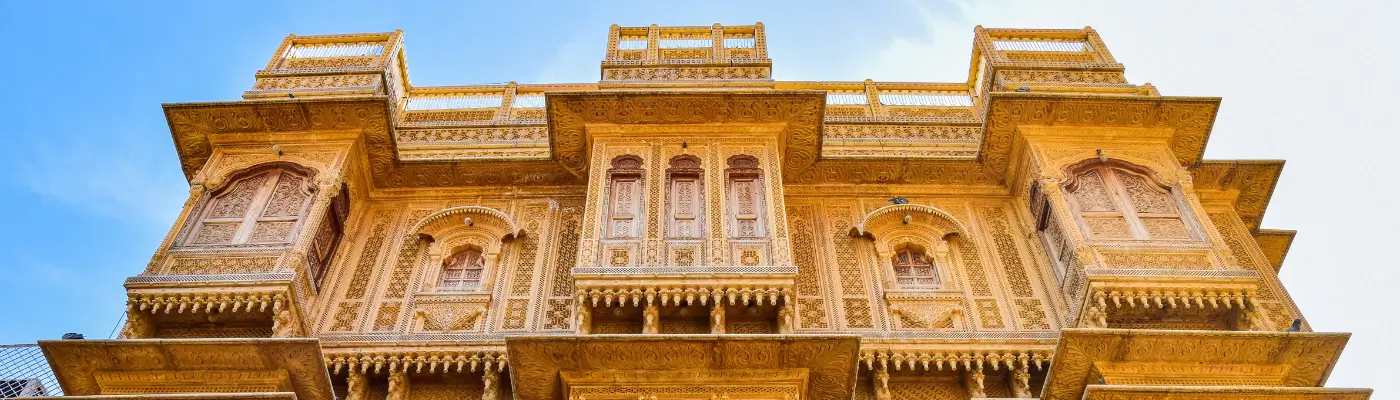
The havelis of Jaisalmer are golden-sandstone mansions preserving the artistry and domestic life of the city’s former merchant and administrative families. Their carved façades, projecting jharokhas, latticed screens, courtyards, murals and mirrorwork show how beauty, privacy, ventilation and desert climate were united in one architectural language. The main heritage circuit includes Patwon Ki Haveli, a cluster of five mansions: Nathmal Ki Haveli, admired for its subtly different twin façades and carved elephants: and Salim Singh Ki Haveli, recognised by its dramatic upper structure and peacock-shaped brackets.
Some sections operate as museums, while others remain private or partly occupied, so access and photography rules differ. A guided walk helps visitors separate documented history from local legend and notice details easily missed in the old-city lanes. Together, these havelis show that Jaisalmer’s splendour was shaped by rulers, traders, craftsmen and families.
Allow Rang Mahal, Jaisalmer to arrange a private vehicle, knowledgeable local guide and carefully paced tour of the city’s magnificent havelis, fort and markets.
Book now for a curated heritage experience and ask about available seasonal offers.
| Detail | Visitor information |
|---|---|
| Principal havelis | Patwon Ki Haveli, Nathmal Ki Haveli and Salim Singh Ki Haveli |
| Recommended duration | 3–4 hours for all three |
| Short tour | 1–1½ hours for Patwon Ki Haveli |
| Best season | October to March |
| Best time | 9:00 AM–12:00 PM |
| Recommended transport | Private vehicle to the old city, followed by walking or an auto-rickshaw |
| Walking distance | Approximately 2–3 km for a complete old-city circuit |
| Entry tickets | Separate tickets or donations may apply at different properties |
| Accessibility | Limited due to narrow stairs, thresholds and uneven lanes |
| Photography | Depends on the individual haveli and museum section |
Patwon Ki Haveli is used as the reference point because it is the most comprehensive starting place for a Jaisalmer haveli tour. Distances and travel times are approximate and may change with traffic, parking and the exact old-city drop-off point.
| Starting point | Approximate distance | Travel time | Recommended mode |
|---|---|---|---|
| Rang Mahal, Jaisalmer | 4–6 km | 15–25 minutes | Private vehicle or auto-rickshaw |
| Jaisalmer Railway Station | 2–3 km | 10–15 minutes | Taxi or auto-rickshaw |
| Jaisalmer Airport | 12–15 km | 25–35 minutes | Pre-booked private vehicle |
| Jaisalmer Fort | 1–1.5 km | 5–10 minutes by auto or 10–20 minutes on foot | Walking or auto-rickshaw |
Private vehicle: Best for reaching the edge of the old city from Rang Mahal, Jaisalmer. Large vehicles may not enter every narrow heritage lane.
Auto-rickshaw: Often the most convenient last-mile option because it can navigate closer to the old-city attractions.
Guided walking tour: Recommended for travelling between the havelis while observing smaller façades, markets and street architecture.
Cycle or two-wheeler: Possible for experienced riders, but parking and pedestrian congestion make it less convenient during busy periods.
Patwon Ki Haveli is a cluster of five sandstone mansions associated with the prosperous Patwa merchant family. The complex was initiated by Guman Chand Patwa in the early 19th century and developed over several decades. Its richly carved façades, jharokhas, arches, murals, mirrorwork and museum collections make it the most comprehensive haveli experience in Jaisalmer.
Best for: First-time visitors, architecture enthusiasts, families and museum lovers.
Main advantages:
Points to consider:
Suggested time: 60–90 minutes.
Nathmal Ki Haveli was commissioned as the residence of Diwan Mohata Nathmal, a prime minister of the Jaisalmer kingdom. Its construction is associated with 1885. A popular account says two craftsman brothers, Hathi and Lulu, worked on opposite sides, creating façades that appear similar but differ in their details. Carved sandstone elephants stand prominently near the entrance.
Best for: Façade photography, stone-carving appreciation and a shorter heritage stop.
Main advantages:
Points to consider:
Suggested time: 20–40 minutes.
Salim Singh Ki Haveli is associated with Salim Singh, an influential prime minister of Jaisalmer. Its most recognisable features are its projecting upper structure, curved roofline, carved balconies and brackets designed in peacock forms. Rajasthan Tourism notes that part of the building remains occupied by descendants of its original residents.
Best for: Distinctive architecture, folklore and exterior photography.
Main advantages:
Points to consider:
Suggested time: 30–45 minutes.
| Feature | Patwon Ki Haveli | Nathmal Ki Haveli | Salim Singh Ki Haveli |
|---|---|---|---|
| Main identity | Five-mansion merchant complex | Diwan’s residence with twin façades | Ministerial mansion with dramatic upper structure |
| Best feature | Carved façades, interiors and museum displays | Subtle asymmetry and carved elephants | Peacock-shaped brackets and projecting balconies |
| Typical visit | 60–90 minutes | 20–40 minutes | 30–45 minutes |
| Interior access | Available in selected sections | Limited or variable | Limited and variable |
| Physical effort | Moderate to high | Low if viewed mainly from outside | Moderate |
| Crowd level | Usually the busiest | Generally moderate | Moderate |
| Best for seniors | Exterior and selected lower areas | Exterior viewing | Exterior and accessible lower areas |
| Best single choice | Yes | Add-on attraction | Add-on attraction |
| Months | Approximate conditions | Recommended time |
|---|---|---|
| November–February | Cool mornings and comfortable days: approximately 5–33°C | 9:00 AM–12:00 PM or 2:30–4:30 PM |
| March | Pleasant mornings but warm afternoons: approximately 13–39°C | 9:00–11:30 AM |
| April–June | Extremely hot temperatures may exceed 40–45°C | Visit immediately after opening and keep the circuit short |
| July–September | Hot, occasionally humid, with possible rain | Morning after checking lane and weather conditions |
| October | Warm days and improving evenings approximately 18–40°C | 9:00–11:30 AM or late afternoon |
Plan the haveli tour between October and March, beginning at approximately 9:00 AM. Morning light reveals the depth of the sandstone carvings and the lanes are generally more comfortable before midday.
The official Incredible India page currently lists Patwon Ki Haveli as open from 9:00 AM to 5:00 PM daily. Hours for different sections and other havelis should be reconfirmed locally.
| Season | Recommended clothing |
|---|---|
| November–February | Comfortable layers, light jacket or shawl and closed walking shoes |
| March and October | Cotton clothing, sunglasses, hat and comfortable shoes |
| April–June | Loose full-sleeved cotton clothes, hat and strong sun protection |
| July–September | Light quick-drying clothes and non-slip footwear |
Modest clothing is recommended because the route passes homes, shops and places of worship.
Avoid large backpacks because the interiors, corridors and staircases can be narrow.
| Traveller | Special preparation |
|---|---|
| Adults | Wear non-slip shoes and plan short hydration breaks |
| Infants | Use a secure baby carrier strollers are difficult in narrow lanes and on stairs |
| Children | Supervise them near balconies, railings, displays and steep steps |
| Pregnant travellers | Limit steep staircases and crowded upper levels take frequent seated breaks |
| Senior citizens | Choose a shorter façade-focused circuit with the vehicle nearby |
| Guests with limited mobility | Confirm ground-level access complete interior access is generally difficult |
The old-city haveli circuit passes markets where traditional snacks and beverages may be available.
Suggested choices include:
Select hygienic, established outlets and use filtered or sealed water. Avoid taking food or uncovered beverages inside museum areas.
After the heritage walk, guests can return to Rang Mahal, Jaisalmer for breakfast, lunch, hi-tea or a relaxed traditional dinner.
Infants: Use a carrier rather than a stroller and avoid crowded stairways during peak hours.
Children: Supervise them closely around balconies, exhibits and traffic-filled lanes.
Adults: Stay hydrated and take breaks if climbing several levels.
Pregnant travellers: Avoid steep or congested stairs if uncomfortable and choose lower-level viewing.
Senior citizens: Consider one principal haveli and an exterior tour of the others rather than climbing every level.
Guests with asthma: Carry prescribed medication because lanes and interiors may contain dust.
Guests with vertigo or claustrophobia: Avoid narrow upper staircases and high balconies.
For emergencies, dial 112. Rajasthan also lists 108 for emergency medical assistance and 100 for police assistance.
This information provides general travel guidance and does not replace medical advice.
The haveli tour can be combined with:
Jaisalmer Fort + Patwon Ki Haveli + Nathmal Ki Haveli + Salim Singh Ki Haveli + Gadisar Lake creates a complete full-day Golden City heritage experience.
Timings should be adjusted according to current opening hours, traffic, weather and guest mobility.
Complete your Jaisalmer itinerary with:
Rang Mahal, Jaisalmer can create a private sightseeing itinerary combining the havelis with the fort, lake, markets, desert activities and dining experiences.
The principal havelis are Patwon Ki Haveli, Nathmal Ki Haveli and Salim Singh Ki Haveli.
Patwon Ki Haveli is the best single choice because it offers the most extensive architecture, selected interiors and museum displays.
Allow approximately three to four hours for all three. Patwon Ki Haveli alone generally requires 60–90 minutes.
Patwon Ki Haveli is approximately 4–6 km from Rang Mahal, Jaisalmer and normally takes 15–25 minutes by vehicle.
Yes. The main havelis lie within Jaisalmer’s old-city area, although the complete circuit involves approximately 2–3 km of walking through uneven and busy lanes.
The official Incredible India page currently lists Patwon Ki Haveli from 9:00 AM to 5:00 PM daily. Hours for different museum sections, Nathmal Ki Haveli and Salim Singh Ki Haveli should be confirmed locally.
No combined ticket should be assumed. Different havelis and museum sections may have separate tickets, donations or access arrangements.
Photography rules vary. Some sections permit personal photography, while flash, tripods, videos or commercial shoots may require permission or an additional charge.
Complete wheelchair access is generally not available because of narrow lanes, high thresholds and steep staircases. Exterior and selected ground-level viewing may still be possible.
Yes, but children require close supervision near balconies, fragile displays and steep stairs.
Parts of these properties may remain private or occupied. Visitors must respect signs, barriers and residential areas.
A guide is not compulsory, but a knowledgeable guide can explain the architecture, merchant history and difference between documented events and folklore.
Yes. Rang Mahal, Jaisalmer can arrange private transport, an experienced local guide and a customised fort, haveli, market and Gadisar Lake itinerary.
"सोनार नगरी री हवेलियां देखो—हर झरोखो बीते वैभव री बात कहे, अर हर नक्काशी मन में बस जावै।"
"Behold the havelis of the Golden City—every window recalls an age of splendour, and every carving finds a place in the heart."
Walk through these golden lanes slowly, for Jaisalmer’s most beautiful stories are often written in the smallest details.
