
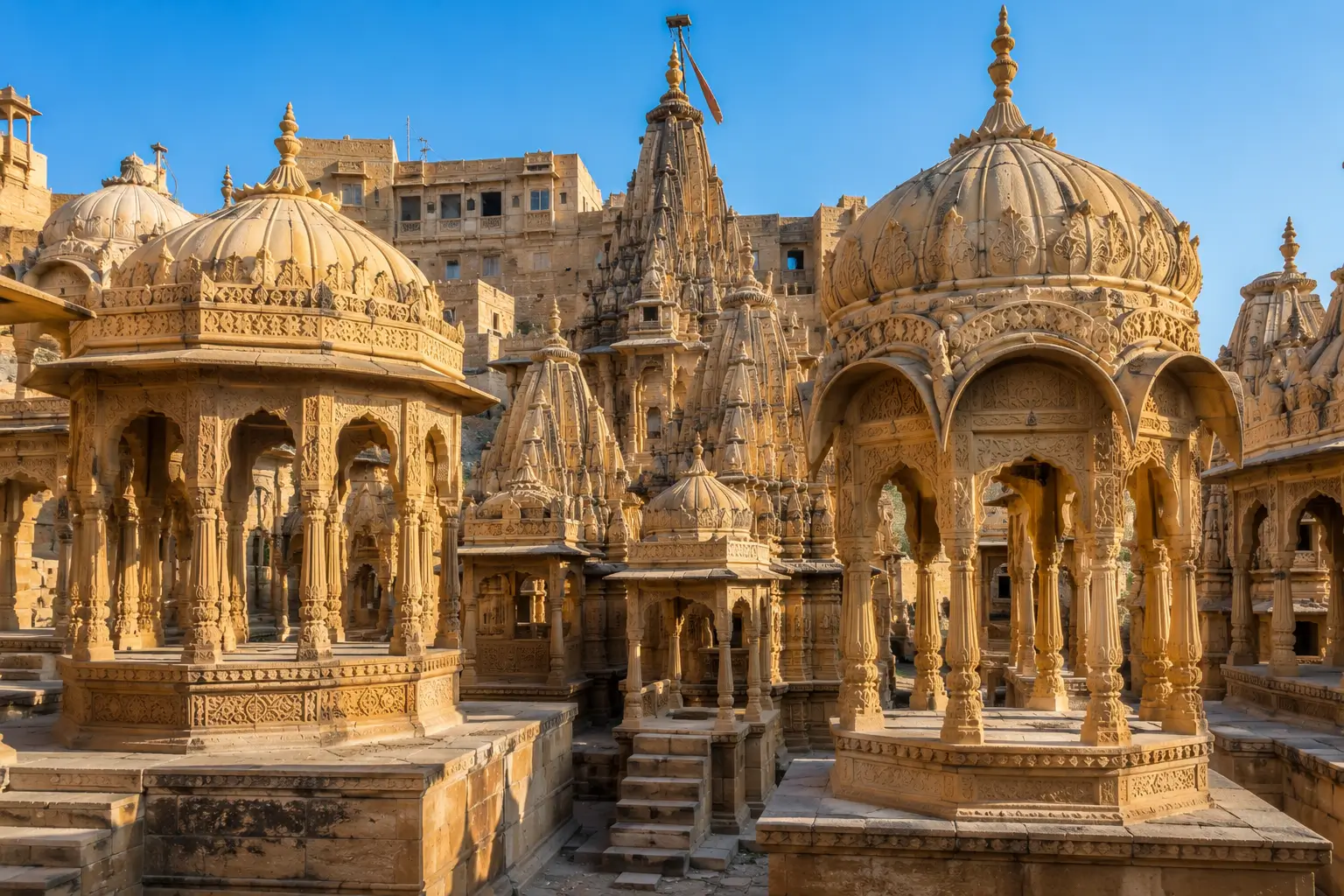
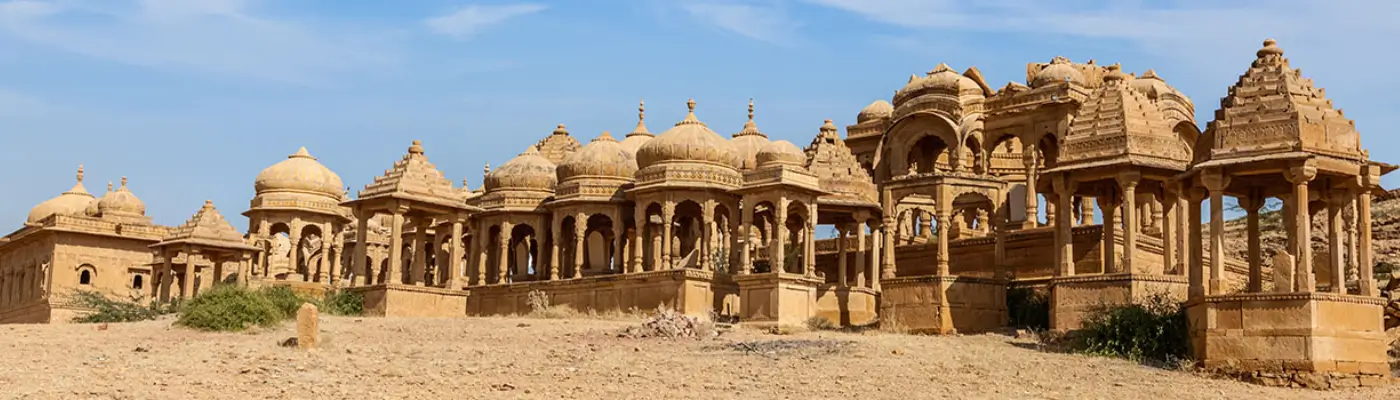
The Jain Temples of Jaisalmer form a sacred cluster of seven shrines inside the living Jaisalmer Fort, where devotion and yellow-sandstone craftsmanship meet. Built between the 12th and 15th centuries, the interconnected temples honour Jain Tirthankaras, with Parshvanath Bhagwan’s shrine regarded as the principal temple. Carved arches, pillars, ceilings, screens and narrative panels create remarkable detail, while the atmosphere reminds visitors that this is first a place of worship and only then a heritage attraction.
Other shrines are associated with Sambhavanath, Adinath or Rishabhdev, Shantinath, Shitalnath, Chandraprabhu and Kunthunath. Beyond the fort, Lodurva’s Parshvanath temple and the Jain temple near Amar Sagar offer quieter excursions. Morning entry, modest clothing, removal of footwear and observance of current rules for leather articles, food and photography are essential. A sensitive visit reveals Jain ideals of restraint and non-violence without interrupting worship.
Allow Rang Mahal, Jaisalmer to arrange your private transfer, knowledgeable local guide, temple visit and a thoughtfully paced heritage tour of Jaisalmer Fort.
Book now for a curated spiritual and architectural journey, with seasonal offers subject to availability.
| Detail | Visitor information |
|---|---|
| Main location | Inside Jaisalmer Fort |
| Number of principal shrines | Seven interconnected Jain temples |
| Historical period | Primarily 12th–15th centuries |
| Principal shrine | Parshvanath Bhagwan Temple |
| Recommended duration | 1–2 hours |
| Best visiting period | October to March |
| Best time of day | Approximately 8:00–11:00 AM |
| Visitor access | Commonly concentrated in the morning |
| Footwear | Must be removed |
| Food | Should not be carried inside |
| Leather articles | May be restricted follow current temple instructions |
| Photography | Permission or a separate charge may apply |
| Accessibility | Challenging because of an uphill approach, thresholds and steps |
Names and transliterations can vary between temple signage and visitor references. The complex is commonly associated with these Tirthankaras:
| Temple or dedication | Significance |
|---|---|
| Parshvanath Bhagwan | The 23rd Tirthankara and principal shrine of the complex |
| Adinath or Rishabhdev | The 1st Tirthankara |
| Sambhavanath | The 3rd Tirthankara |
| Chandraprabhu Swami | The 8th Tirthankara |
| Shitalnath | The 10th Tirthankara |
| Shantinath | The 16th Tirthankara |
| Kunthunath | The 17th Tirthankara |
Visitors should follow the names displayed by the temple trust because individual sanctums may be grouped differently in published guides.
A historic manuscript repository known as the Gyan Bhandar is associated with Jaisalmer’s Jain heritage. Access to manuscripts, underground chambers or restricted collections should never be assumed and must be confirmed with the responsible authority.
The following distances refer to the Jain temple cluster inside Jaisalmer Fort. Vehicles normally drop visitors near the main fort access, after which an uphill walk through the living fort is required.
| Starting point | Approximate distance to fort area | Travel time | Additional temple access |
|---|---|---|---|
| Rang Mahal, Jaisalmer | 3–4 km | 10–20 minutes | Approximately 10–20 minutes uphill on foot |
| Jaisalmer Railway Station | 3–4 km | 10–20 minutes | Continue through the fort lanes on foot |
| Jaisalmer Airport | 14–17 km | 25–35 minutes | Vehicle to fort access, followed by walking |
| Jaisalmer Fort entrance | 400–800 metres | 10–20 minutes | Uphill walk through narrow lanes |
Distances depend on the chosen parking point, traffic and current access restrictions.
Private vehicle: Best for travelling from Rang Mahal, Jaisalmer to the fort’s nearest permitted drop-off point.
Auto-rickshaw: Convenient for reaching closer to the fort entrance through busy city roads.
Authorised last-mile service: Golf carts or other approved services may operate between designated points. Availability and charges should be confirmed locally.
Walking: Required for much of the final approach because the temples are inside a living hill fort with narrow lanes.
This is the most important choice for first-time visitors. The cluster combines spiritual significance with highly detailed medieval sandstone architecture.
Access: Uphill walk inside Jaisalmer Fort.
Comfort: Limited seating, narrow passages, thresholds and stairs.
Environment: Active place of worship within a busy living fort.
Main advantages:
Points to consider:
Lodurva, approximately 15–17 km from Jaisalmer, was the earlier capital of the Bhati rulers. Its celebrated Jain temple is dedicated to Parshvanath, the 23rd Tirthankara, and is admired for its carved gateway, jaali work, yellow-stone architecture and Kalpavriksha or “Tree of Life” imagery.
Access: Paved road by private vehicle approximately 25–35 minutes from Jaisalmer.
Comfort: Easier vehicle access and a more open setting than the fort.
Environment: Quiet village and pilgrimage atmosphere.
Main advantages:
Points to consider:
The Jain temple near Amar Sagar forms part of a quieter heritage landscape approximately 7 km west of Jaisalmer. It can be combined with Amar Sagar Lake, the palace complex and nearby desert scenery.
Access: Private car or taxi from Jaisalmer.
Comfort: Easier road access but limited visitor facilities.
Environment: Less crowded and more contemplative.
Main advantages:
Points to consider:
| Feature | Fort Jain Temples | Lodurva Temple | Amar Sagar Temple |
|---|---|---|---|
| Main attraction | Seven interconnected medieval shrines | Parshvanath pilgrimage temple | Quiet temple and heritage landscape |
| Distance from central Jaisalmer | Inside Jaisalmer Fort | Approximately 15–17 km | Approximately 7 km |
| Physical effort | Moderate to high | Low to moderate | Low to moderate |
| Crowd level | Usually highest | Moderate | Usually lower |
| Architectural experience | Most extensive | Highly ornate and distinctive | Smaller and peaceful |
| Suitable for seniors | With reduced walking and assistance | Generally more comfortable | Generally more comfortable |
| Suitable for first-time visitors | Yes | Excellent additional excursion | Optional heritage addition |
| Suggested duration | 1–2 hours | 45–75 minutes | 30–60 minutes |
| Months | Approximate conditions | Recommended time |
|---|---|---|
| November–February | Cool mornings and comfortable days approximately 5–33°C | 8:00–11:00 AM |
| March | Pleasant mornings with hot afternoons approximately 13–39°C | 8:00–10:30 AM |
| April–June | Extremely hot temperatures may exceed 40–45°C | Visit immediately after morning opening |
| July–September | Hot and occasionally humid with possible rain | Morning after checking fort-lane conditions |
| October | Warm days and increasingly pleasant mornings | 8:00–11:00 AM |
Visit between October and March, preferably before 11:00 AM. Many visitor references currently report that the fort temples admit sightseers mainly between approximately 8:00 AM and noon, but worship, festival and trust arrangements can alter access.
During Paryushan, Mahavir Jayanti and other religious occasions, devotee numbers may increase and tourist access may be temporarily restricted. Religious observance must always take priority over sightseeing.
| Season | Suggested clothing |
|---|---|
| November–February | Modest layers, light jacket or shawl and comfortable shoes |
| March and October | Breathable cotton clothing, hat and sunglasses for the approach |
| April–June | Full-sleeved cotton clothes and strong sun protection |
| July–September | Light quick-drying clothes and non-slip footwear |
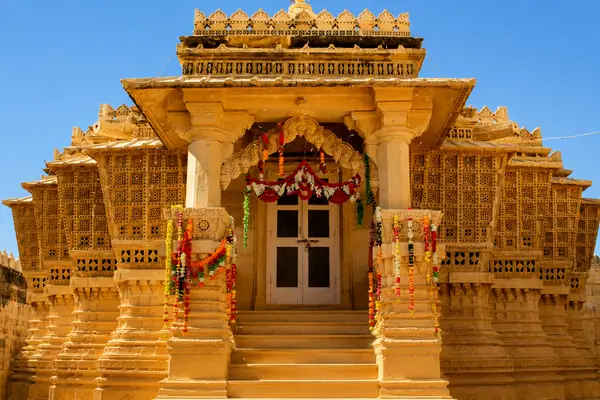
Food, tobacco products, alcohol and leather articles may be restricted. Follow instructions at the entrance rather than relying on older online information.
| Traveller | Special preparation |
|---|---|
| Adults | Dress modestly, maintain silence and allow time for the uphill walk |
| Infants | Use a secure carrier strollers are difficult inside the fort |
| Children | Explain worship etiquette and supervise them near carvings, lamps and steps |
| Pregnant travellers | Use last-mile assistance where available and avoid rushing uphill |
| Senior citizens | Visit one or two principal shrines and plan seated breaks |
| Guests with limited mobility | Confirm current assistance and ground-level access before departure |
A temple visit can be combined with a carefully arranged vegetarian or Jain meal.
Suggested dishes include:
Jain dietary practices vary by individual and level of observance. Some guests may request:
Guests should communicate their exact requirements in advance rather than requesting only “Jain food.”
Rang Mahal, Jaisalmer can assist with a Jain-friendly meal when requirements are shared beforehand and confirmed by the kitchen.
Food and beverages should not be taken into temple interiors unless specifically permitted.
Facilities may include:
Facilities may include:
Infants: Avoid crowded hours and use a carrier rather than a stroller.
Children: Keep them away from lamps, ritual objects, balconies and fragile carvings.
Adults: Hydrate before climbing the fort and avoid visiting after alcohol consumption.
Pregnant travellers: Take a slower route and avoid crowded, steep staircases if uncomfortable.
Senior citizens: Use authorised transport as far as possible and limit the number of internal levels visited.
Guests with asthma: Carry prescribed medication because the lanes and interiors may contain dust.
Guests with heart or mobility conditions: Consult a doctor when necessary and keep a companion and vehicle available.
For emergencies, dial 112. Rajasthan also lists 108 for medical emergencies and 100 for police assistance.
This information provides general travel and temple-etiquette guidance and does not replace medical advice or official temple instructions.
Jaisalmer Fort + Jain Temple Complex + Fort Palace + old-city havelis + Gadisar Lake creates a complete city heritage tour.
For a specialised spiritual itinerary, choose:
Fort Jain Temples + Lodurva Parshvanath Temple + Amar Sagar Jain Temple.
| Approximate time | Suggested activity |
|---|---|
| 7:30 AM | Departure from Rang Mahal, Jaisalmer |
| 8:00 AM | Arrival near Jaisalmer Fort |
| 8:15–10:00 AM | Jain Temple Complex |
| 10:00–11:30 AM | Fort Palace, lanes and viewpoints |
| 12:00 PM | Return to Rang Mahal, Jaisalmer |
| Approximate time | Suggested activity |
|---|---|
| 7:30 AM | Departure from Rang Mahal, Jaisalmer |
| 8:00–10:00 AM | Fort Jain Temple Complex |
| 10:30 AM | Drive towards Lodurva |
| 11:00 AM–12:00 PM | Lodurva Jain Temple |
| 12:30 PM | Amar Sagar Jain Temple |
| 1:30 PM | Return for a pre-arranged Jain lunch |
All timings remain subject to current temple access, worship and weather.
Rang Mahal, Jaisalmer can combine the Jain temples with selected heritage, spiritual, village and desert experiences in a private itinerary.
The complex is commonly described as seven interconnected Jain temples dedicated to different Tirthankaras.
Parshvanath Bhagwan Temple, dedicated to the 23rd Tirthankara, is regarded as the principal shrine.
Rajasthan Tourism and Incredible India date the principal fort temples between the 12th and 15th centuries.
Visitor entry is commonly concentrated between approximately 8:00 AM and noon. Current timings must be confirmed because worship, festivals and trust instructions can change access.
Jaisalmer Fort is approximately 3–4 km from Rang Mahal, Jaisalmer. After reaching the fort area, allow another 10–20 minutes for the uphill approach.
Non-Jain visitors are generally welcomed during designated hours, provided they follow dress, footwear, photography and worship rules.
Entry, camera and guide charges may differ by visitor category and current temple policy. Confirm the latest amount at the authorised counter.
Photography may be permitted in selected areas after approval or payment of a camera charge. Flash, video, tripods and commercial photography may be restricted.
Leather belts, bags, wallets and other products may be restricted. Follow the instructions displayed at the entrance.
Access to manuscripts, underground chambers or restricted collections is not guaranteed. Special permission may be required.
Complete wheelchair access is difficult because of the fort’s incline, thresholds, narrow passages and steps. Confirm current last-mile and ground-level arrangements.
Yes. Lodurva offers a quieter pilgrimage environment, intricate stone architecture and easier vehicle access than the fort temple complex.
Yes, but exact restrictions—such as no onion, garlic or root vegetables—should be communicated in advance. Rang Mahal, Jaisalmer can assist with a confirmed Jain-friendly meal request.
Yes. Rang Mahal, Jaisalmer can assist with private transportation, a local guide, temple coordination and a combined Jaisalmer Fort, Lodurva and Amar Sagar itinerary.
"सोनार किले रा पावन जिनालय—जठै पत्थर में कला, अर मन में शांति बसै।"
"The sacred Jain temples of the Golden Fort—where art lives in stone and peace resides in the heart."
Enter with humility, observe with patience and carry the temple’s quiet message of peace into the rest of your journey.
