
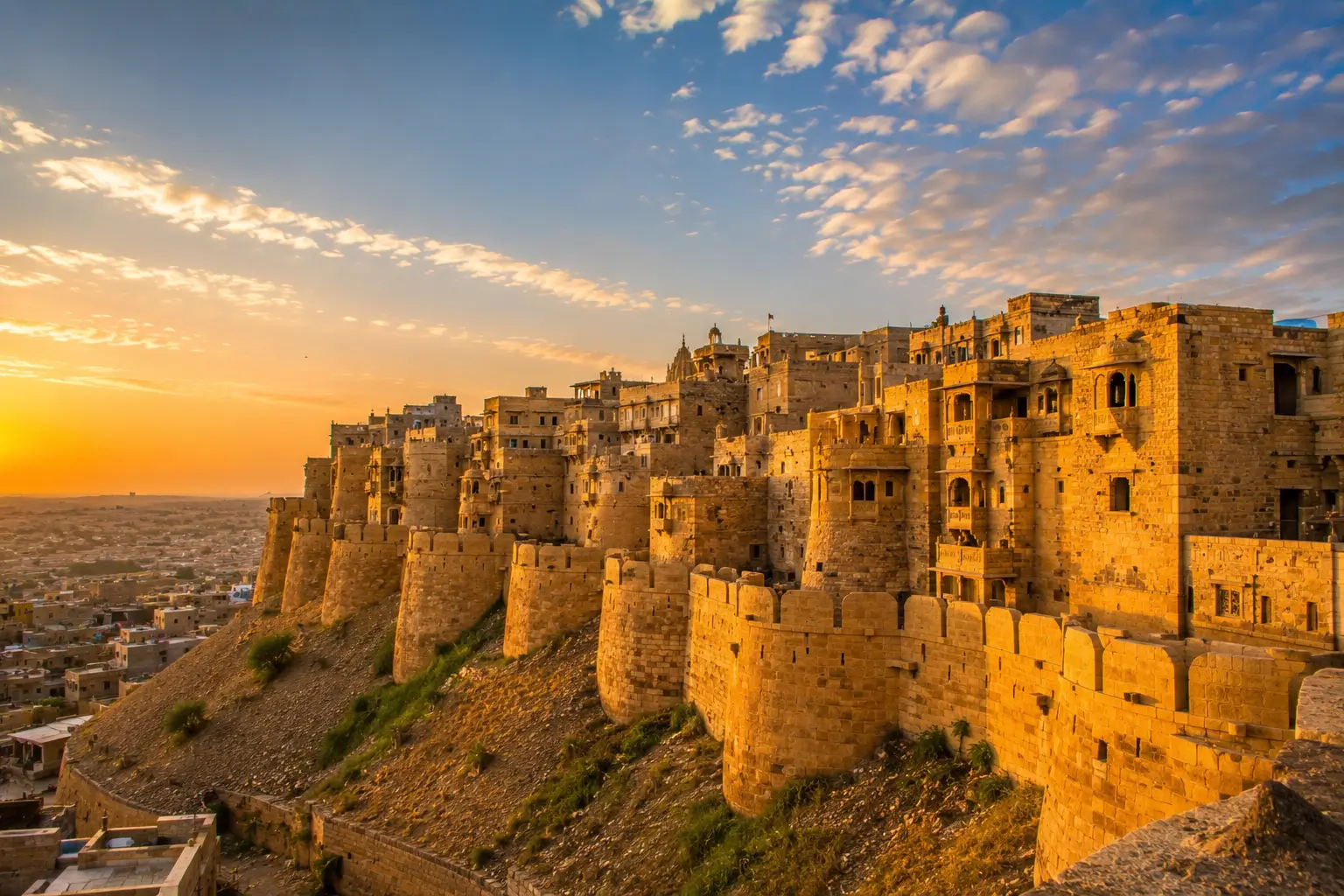
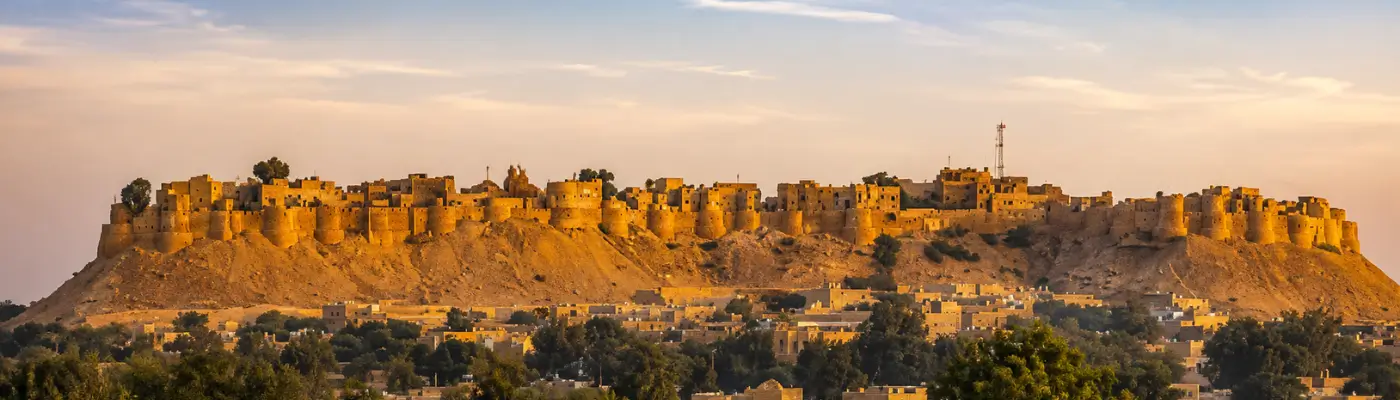
Rising above the Golden City on Trikuta Hill, Jaisalmer Fort—also called Sonar Quila or the Golden Fort—is Rajasthan’s celebrated living desert citadel. Founded in 1156 by Rawal Jaisal, it remains home to families, temples, shops and age-old neighbourhoods rather than functioning only as a monument. Its honey-yellow sandstone walls appear golden in sunlight, while winding lanes reveal carved façades, viewpoints and centuries of everyday heritage.
The fort forms part of UNESCO’s Hill Forts of Rajasthan World Heritage Site, inscribed in 2013. Visitors can walk through its historic gateways, explore the Fort Palace Museum, admire the group of Jain temples, visit Laxminath Temple and observe local life—always remembering that this magnificent attraction is also a sacred, inhabited community.
Enter the Golden Fort with the ease of a royal guest. Rang Mahal, Jaisalmer can curate your visit with comfortable transfers, suitable guide assistance and a sightseeing sequence designed around your interests and mobility.
Book your stay and curated Jaisalmer tour now to discover exciting seasonal offers and thoughtfully planned royal experiences.
| Visitor information | Guidance |
|---|---|
| Other names | Sonar Quila, Sonar Qila, Golden Fort |
| Location | Trikuta Hill, central Jaisalmer |
| Heritage status | Part of UNESCO’s Hill Forts of Rajasthan World Heritage Site |
| Recommended duration | 2–3 hours allow 3–4 hours with temples, museum and shopping |
| General entry | A single ticket is normally not required for the public residential lanes |
| Separate tickets | Fort Palace Museum, certain temple areas, guide and photography charges may apply |
| Suggested sightseeing window | Approximately 8:00 AM–6:00 PM |
| Jain temple access | Commonly available during morning hours verify the current schedule |
| Physical difficulty | Moderate: uphill approach, uneven lanes and numerous steps |
| Best season | October to March |
| Best for | Heritage lovers, families, photographers, architecture and culture enthusiasts |
Important: Jaisalmer Fort is a living settlement, not one uniformly controlled museum. Temple, museum, festival, conservation and security schedules can change independently. Confirm same-day timings and charges before departure.
Distances and journey times below are approximate and calculated up to the principal fort entrance or designated vehicle drop-off area.
| Starting point | Approximate distance | Suggested mode | Approximate travel time |
|---|---|---|---|
| Jaisalmer Railway Station | 1.5–2.5 km | Auto-rickshaw, taxi or pre-arranged transfer | 8–15 minutes |
| Jaisalmer Airport | 14–17 km | Pre-booked taxi or private car | 25–35 minutes |
| Rang Mahal, Jaisalmer | 3–4 km | Private hotel transfer, taxi or auto-rickshaw | 10–15 minutes |
| Jaisalmer Fort entrance | 0 km | Walk through the gateways | 5–15 minutes to reach the central visitor area |
| Visit option | Access and comfort | Environment | Main advantages | Points to consider |
|---|---|---|---|---|
| Essential Living-Fort Walk — 60–90 minutes | Moderate uphill walking fewer interiors | Lively lanes, homes, shops and courtyards | Flexible, family-friendly and ideal for limited time | Less historical depth without a knowledgeable guide |
| Temple and Architecture Route — 90–150 minutes | Steps and footwear removal morning visit recommended | Sacred, detailed and relatively peaceful | Exceptional Jain carvings, Laxminath Temple and spiritual heritage | Restricted timings, modest dress and photography rules apply |
| Fort Palace Museum Route — 90–120 minutes | Numerous narrow or steep stairs | Royal chambers, artefacts and elevated views | Stronger understanding of Jaisalmer’s rulers and architecture | Separate ticket not comfortable for every senior or mobility-restricted guest |
| Complete Fort and Old-City Circuit — 3–4 hours | Sustained walking with rest stops required | Heritage lanes, temples, palace, markets and viewpoints | Most comprehensive cultural experience | Can become tiring, crowded and hot without careful planning |
October to March is the most comfortable season. Visit between 8:00 AM and 11:30 AM for temples and quieter lanes, or approximately 3:30 PM to 5:30 PM for warm golden light. Attraction closing times must be checked before planning a late visit.
| Months | Preferred time | Broad published city temperature range | Visitor guidance |
|---|---|---|---|
| November–February | 8:00–11:30 AM : 3:30–5:30 PM | Approximately 5–33°C | Best overall weather: mornings and evenings can be cold |
| March and October | 8:00–11:00 AM | Approximately 13–40°C | Pleasant mornings but increasingly hot afternoons |
| April–June | 7:00–9:30 AM only | Approximately 19–46°C | Extreme heat is possible avoid noon and early afternoon |
| July–September | 7:30–10:00 AM | Approximately 22–43°C | Heat, humidity and occasional rain can make stone surfaces slippery |
These are broad monthly indicators, not a daily forecast. Check the current Jaisalmer weather and any heat advisory before visiting.
October to March
April to September
| Traveller | What to wear or carry |
|---|---|
| Adults | Grip footwear, water, sun protection, identity document, small hands-free bag and phone |
| Infants and toddlers | Light protective clothing, shade cover, feeding supplies, wipes and medically appropriate hydration avoid direct midday heat |
| Children | Cap, water bottle, comfortable shoes and a card carrying the guardian’s contact number |
| Pregnant women | Loose clothing, water, light snack, prescribed medicines and supportive footwear travel with a companion |
| Senior citizens | Walking stick if normally used, anti-slip footwear, regular medicines, water and emergency contact details |
| Mobility-restricted guests | Minimal luggage, a companion and a pre-planned shorter route avoiding steep interiors |
A stroller can be difficult to use in narrow lanes and on steps. A carrier should only be used if it is secure, comfortable and does not cause the child or caregiver to overheat.
Enhance the Golden Fort experience with selected local flavours from a clean and reputable outlet:
Drink sealed or properly filtered water. During hot weather, avoid excessive alcohol, very heavy meals and beverages from unhygienic sources.
| Facility | Availability and practical guidance |
|---|---|
| Parking and drop-off | Designated areas are available below or near the fort entrance locations can change with traffic controls |
| Auto-rickshaws and e-rickshaws | Commonly available around the fort and old city |
| Golf carts | May operate from the lower access area, subject to municipal availability |
| Guides | Local guides are available select an authorised or verifiable guide and confirm charges |
| Ticket counters | Available at individually ticketed attractions such as the Fort Palace Museum |
| Restaurants and cafés | Numerous small eateries and rooftop establishments operate inside and around the fort |
| Shopping | Textiles, jewellery, leather alternatives, handicrafts, souvenirs and local artwork |
| Toilets | Available at selected visitor points, but cleanliness and accessibility may vary |
| Seating and shade | Limited in some lanes cafés and courtyards can provide planned rest stops |
| ATMs and pharmacies | Available in the surrounding old-city market do not rely on finding every service inside |
| Mobile connectivity | Generally available, although reception may vary within dense structures |
| Wheelchair access | Limited because of slopes, cobbles, thresholds and stairs continuous step-free access should not be assumed |
| Medical assistance | Pharmacies and medical facilities are available in Jaisalmer city immediate first aid inside every section is not guaranteed |
Dizziness, confusion, fainting, severe weakness, repeated vomiting or unusually hot skin can indicate serious heat illness. Move the person to shade or a cooler place, loosen excess clothing and provide water or a rehydrating drink only if the person is conscious and able to swallow. Seek urgent assistance through 112 or Rajasthan emergency services on 108.
This information provides general travel guidance and does not replace medical advice.
| Nearby attraction | Approximate distance from the fort | Why combine it |
|---|---|---|
| Manak Chowk and old-city markets | Adjacent | Local shopping, street life and heritage façades |
| Nathmal Ki Haveli | Around 1 km | Detailed yellow-sandstone craftsmanship |
| Salim Singh Ki Haveli | Around 1–1.5 km | Distinctive projecting architecture and peacock-style brackets |
| Patwon Ki Haveli | Around 1–1.5 km | Jaisalmer’s celebrated merchant-haveli complex |
| Mandir Palace and Tazia Tower | Around 1–2 km | Royal architecture and carved balconies |
| Gadisar Lake | Around 1.5–2.5 km | Boating, temples and attractive evening views |
| Desert Cultural Centre | Near Gadisar Lake | Puppetry, folklore and regional cultural interpretation |
Begin with the Jain temples and Fort Palace Museum in the morning, continue through the old market to Patwon Ki Haveli, and finish at Gadisar Lake around sunset. Allow a full day with meal and rest breaks.
Rang Mahal, Jaisalmer can combine the fort with selected city attractions, desert experiences and comfortable transportation according to the guest’s available time.
Its yellow sandstone takes on a glowing golden colour in sunlight, inspiring the names Sonar Quila, Sonar Qila and Golden Fort.
Walking through the public residential lanes normally does not require one common fort ticket. Separate charges may apply to the Fort Palace Museum, temple visitor areas, guides and photography.
The inhabited fort does not operate exactly like one gated museum. Daylight sightseeing is generally recommended from approximately 8:00 AM to 6:00 PM. Museums and temples maintain separate schedules, with Jain temple visitor access commonly concentrated in the morning.
Allow approximately two to three hours for the principal attractions. A complete visit including temples, museum, viewpoints, shopping and rest stops can require three to four hours.
Jaisalmer Fort is approximately 3–4 km from Rang Mahal, Jaisalmer and normally takes around 10–15 minutes by road, depending on traffic and the permitted drop-off point.
Senior citizens can enjoy selected courtyards and public lanes, but steep slopes, uneven surfaces and museum stairs may be difficult. A shorter route with a companion and convenient drop-off is recommended.
Accessibility is limited. Some lower public areas may be approached with assistance, but uninterrupted wheelchair access should not be expected throughout the historic fort.
Wear modest, breathable clothing and comfortable anti-slip footwear. Shoulders and knees should be covered for temple visits, and footwear or leather articles may need to be removed according to current religious rules.
Exterior and public-lane photography is generally possible, but museums, temples, private homes and commercial premises can impose restrictions. Always check signs and request permission before photographing residents.
Yes. Rang Mahal, Jaisalmer can assist with transportation, itinerary planning and suitable guide coordination, subject to availability and current attraction regulations.
"खम्मा घणी, पधारो म्हारे जैसलमेर—सोनार किले री सुनहरी गलियां थारी यादां में सदा उजास भरती रैवे।"
"Welcome to our Jaisalmer—may the golden lanes of Sonar Quila forever illuminate your memories."
